
Library Record
Images
Metadata
Call# |
CS71 .L943 1971 |
LCNO |
76-152416 |
Summary |
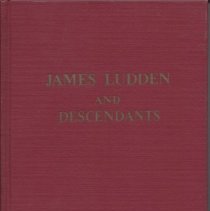
Wallace Ludden was a retired school principal who started studying his family's history after his nephew, Myron Charles Ludden, sparked his curiosity with questions. After his retirement, one of Wallace Ludden's primary hobbies was creating his family's genealogy. He described it as the most fascinating thing that he had ever done. Ludden's genealogy began with the origin of the name and then described the life of James Ludden, who was one of the Old Planters. The descendants of Ludden from generations two through six were grouped and the remainder are grouped based on location. The author found Luddens in Maine, New York, and Vermont. Prominent members and their descendants were given sections of their own, including Samuel Dexter Ludden, Alanzo Payson Ludden, Enos Ludden, Joseph Ludden, and Sarah Brown. Finally, Ludden covered Luddens unconnected to the ancestors he had previously found and individual Luddens whose families he could not find. At completion, eleven generations and over three hundred years of Ludden history had been documented. Illustrations for several members were included, especially for the most prominent individuals. One such member was the family's American patriarch James Ludden, an Old Planter who was born in 1611 in Weymouth, England and moved to Wessaguscus, Weymouth, Massachusetts before 1632. On October 31, 1632, Ludden served Governor John Winthrop as a guide from Plymouth to Weymouth. Ludden even carried the governor across the Indian Head River because the current was too strong for Winthrop to walk across himself. Winthrop noted this event in his diary, calling Ludden Luddam and the river Luddam's Ford. A historic marker and woodcut commemorate the crossing. The party reached Weymouth and were offered a meal including turkey, geese, and duck. Winthrop reached Boston the following day. No other family head of similar name who could have been a guide was living in New England at the time, so Wallace Ludden contended that the Luddam Winthrop described was his ancestor James Ludden. Samuel Dexter Ludden was another Ludden ancestor whose life was described in detail. He was born in New York in 1839 and worked as a clerk at a dry goods establishment starting at age seventeen. He remained there until the Civil War broke out, which he fought in for four years. He continued in the dry goods trade for his whole life, but moved from New York to Illinois and from Illinois to Wisconsin. He was also an active member of Union Park Congregational Church, where he did missionary work and taught Sunday School and an honored member of both the Loyal Legions and the Grand Army of the Republic. In the war, Ludden was in the 8th Heavy Artillery, Company L, and Company K, 12th Regiment New York Volunteers. He served in Washington, D. C. until Irvin McDowell reluctantly sent his barely trained troops to the First Battle of Bull Run. Ludden was a smaller man who hid during his first battle, but regained his courage at the rallying of the troops. He was attached to George B. McClellan's Army of the Potomac for its 1862 Peninsula Campaign and participated in the Siege of Yorktown. He continued in actions that preceded the Battle of Seven Pines. Artillery played an important role in the Battle of Malvern Hill, one of many actions Ludden served in as a artilleryman. He was captured at the Second Battle of Bull Run and sent to Libby Prison in Virginia. He was paroled, captured again at the Battle of Jerusalem Plank Road, and returned to Libby Prison. A Confederate soldier stole his pristine Union uniform in exchange for a shabby Confederate one; Ludden used the Confederate uniform to slip out of the prison unmolested. He trekked through the forest eating berries and food from sympathetic African Americans until he rejoined Union forces in Beverly, West Virginia. He participated in a few smaller battles, including the Battle of Boydton Plank Road, which happened two days before the Third Battle of Petersburg. Robert E. Lee surrendered to Ulysses S. Grant shortly thereafter and Ludden returned to New York with the rank of Major and reentered civilian life. |
Object Name |
Book |
Author |
Wallace Ludden |
Title |
James Ludden The Old Planter 1611-1692 and Descendants |
Publisher |
Privately published |
Published Date |
1971 |
Catalog Number |
CS71 .L943 1971 |
People |
Ludden, Wallace Ludden, Myron Charles Hanners, Roger W. Ludden, James Luddam, James Johnson, Mary Kinham, Alice Winthrop, John Vivian, John Harris Ludden, Joseph Brown, Sarah Ludden, Samuel Dexter Ludden, Martha Jameson Lee, Robert E. Grant, Ulysses S. Ludden, Alonzo Payson Grove, Caroline Ludden, Enos Thayer, Sarah McDowell, Irvin McClellan, George B. |
Search Terms |
Genealogy Maine New York Vermont Unconnected Ancestors Indirect Line Descendants Eleven Generations Photographs Old Planter Guide Weymouth, England Wessaguscus, Weymouth, Massachusetts Governor Plymouth, Massachusetts Boston, Massachusetts Indian Head River Luddam's Ford Woodcut Historic Marker Clerk Dry Goods New York Civil War Union Park Congregational Church Missionary Work Sunday School Teacher Loyal Legions Grand Army of the Republic 8th Heavy Artillery Company L Company K 12th Regiment New York Volunteers First Battle of Bull Run Army of the Potomac Peninsula Campaign Siege of Yorktown Battle of Seven Pines Artillery Battle of Malvern Hill Second Battle of Bull Run Imprisonment Libby Prison Richmond, Virginia Parole Recapture Escape African American Union Sympathizers Beverly, West Virginia Battle of Boydton Plank Road Third Battle of Petersburg Surrender Major Buffalo Hunt |
Accession number |
CS71 .L943 |
Spine Label |
James Ludden and Descendants |
Year Range from |
1611 |
Year Range to |
1970 |